
Ādi Shankara
Adi Shankara (8th c. CE), also called Adi Shankaracharya (Ādi Śaṅkara, Ādi Śaṅkarācārya, pron), was an Indian Vedic scholar-monk, philosopher, and teacher (acharya) of Advaita Vedanta. He wrote influential commentaries on the Brahma sutras and other texts, and in recent times is often revered as the most important Indian philosopher.
Also recorded as Adi Sankarachaarya · Sankaracarya · Aryamba antharjanam · Sankara bhagavatpāda
Ādi Shankara
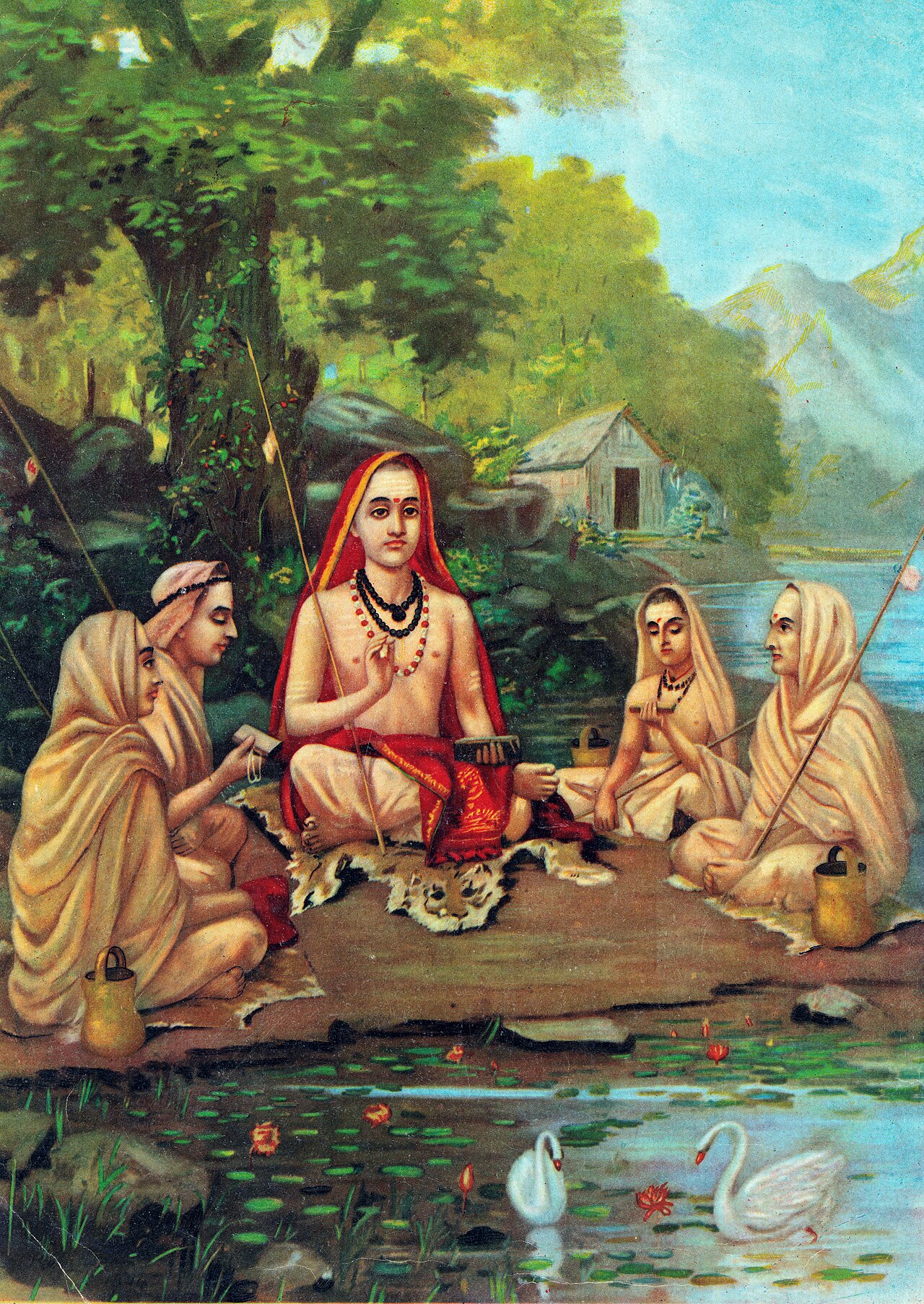
Raja Ravi Varma · Google Arts Culture — adi-shankaracharya/WgFvX3x6i0ckfQ · Public domain
- Born
- c. 700 CE
- Birth Name
- Shankara
- Died
- c. 750 CE
- Known for
- Expounded Advaita Vedanta
- Occupation
- philosopher · writer · poet · guru
- Fields
- philosophy
- Movements
- Bhakti movement
- Teachers
- Govinda Bhagavatpada
- Languages
- Sanskrit · Marathi
VALÉORINE Encyclopedia
VALÉORINE documentary reading
Documentary summary
Adi Shankara (8th c. CE), also called Adi Shankaracharya (Ādi Śaṅkara, Ādi Śaṅkarācārya, pron), was an Indian Vedic scholar-monk, philosopher, and teacher (acharya) of Advaita Vedanta. He wrote influential commentaries on the Brahma sutras and other texts, and in recent times is often revered as the most important Indian philosopher.
Admitted source layer · organised and presented by VALÉORINE
Reference Check
Propose documentary evidence for Ādi Shankara. A contribution is never written directly as fact: identity, source, rights and evidence gates still decide.
Sign in to contribute
World of VALÉORINE
Documentary connections
Only confirmed graph relationships appear here. Images are shown only when their identity and reuse rights both pass the documentary gate.
Documentary evidence
Documentary basis
Authority files
bnf · gnd · loc · wikidata · Q180967
In this article
Biography
Biography
Shankara worked between 788 and 820 across philosopher, writer, poet and guru. The registers place that work in nondualism. Every statement below returns to a source shown in the evidence panel; where the record is silent or divided, the article says so instead of resolving it.
Key facts
Key facts
• Religion — Hinduism • Born — c. 700 CE • Birth Name — Shankara • Died — c. 750 CE • Teacher — Govinda Bhagavatpada • Philosophy — Advaita Vedanta • Honors — Jagadguru • Known for — Expounded Advaita Vedanta
Dating
Dating
Several different dates have been proposed for Shankara. While the Advaita tradition assigns him to the 5th century BCE, the scholarly-accepted dating places Shankara to be a scholar from the first half of the 8th century CE.
Matha datings
Matha datings
The prominent Advaita-mathas date Shankara to the 5th century BCE. This dating is based on records of the heads of Shankara's cardinal institutions s. The exact dates of birth of Adi Shankaracharya believed by several monasteries are Kali 2593 (509 BCE) according to the Kanchipuram, 507 BCE according to Govardhan Math, 491 BCE according to Dvarka (Dvārakā), 485 BCE according to Jyotirmath, 484 BCE according to Jagannatha Puri, and 483 BCE according to Sringeri. The records of the Sringeri Matha state that Shankara was born in the 14th year of the reign of "Vikramaditya", but it is unclear to which king this name refers. Though some researchers identify the name with Chandragupta II (4th century CE), modern scholarship accepts the Vikramaditya as being from the Chalukya dynasty of Badami, most likely Vikramaditya II (733–746 CE).
Other datings
Other datings
• 44–12 BCE: the commentator Anandagiri believed he was born at Chidambaram in 44 BCE and died in 12 BCE. • 6th century CE: Telang placed him in this century. Sir R.G. Bhandarkar believed he was born in 680 CE. • 805–897 CE: Venkiteswara not only places Shankara later than most, but also had the opinion that it would not have been possible for him to have achieved all the works apportioned to him, and has him live ninety-two years.
Traditional views of Shankara
Traditional views of Shankara
Shankara has an unparalleled status in the tradition of Advaita Vedanta. Hagiographies from the 14th-17th centuries portray him as a victor who travelled all over India to help restore the study of the Vedas. According to Frank Whaling, some Hindus, particularly those who follow Advaita, view Shankara as someone who defended Hindu dharma in response to Buddhist and Jain challenges and contributed to the decline of Buddhism in India. His teachings and tradition are central to Smartism and have influenced Sant Mat lineages. Tradition portrays him as the one who reconciled the various sects (Vaishnavism, Shaivism, and Shaktism) with the introduction of the Panchayatna form of worship, the simultaneous worship of five deities – Ganesha, Surya, Vishnu, Shiva, and Devi, arguing that all deities were but different forms of the one Brahman, the invisible Supreme Being, implying that Advaita Vedanta stood above all other traditions.
Historical Shankara and (lack of) early influence (until 10th century)
Historical Shankara and (lack of) early influence (until 10th century)
• Illustration — The birthplace of Adi Shankara at Kalady Scholars have questioned Shankara's early influence in India. The Buddhist scholar Richard E. King states, Although it is common to find Western scholars and Hindus arguing that Shankaracharya was the most influential and important figure in the history of Hindu intellectual thought, this does not seem to be justified by the historical evidence. According to numerous scholars, Shankara and other early Advaitins were probably Vaishnavites, or at least teaching in a Vaishnava-oriented milieu, and Shankara may have had a Pancharatra background. According to Clark, "Shankara was relatively unknown during his life-time, and probably for several centuries after, as there is no mention of him in Buddhist or Jain sources for centuries; nor is he mentioned by other important philosophers of the ninth and tenth centuries." According to King, until the 10th century, Shankara's works seem to have been overshadowed by his older contemporary Maṇḍana Miśra; Roodurmun notes that Maṇḍana was considered the major representative of Advaita. Maṇḍana Miśra, a Mimansa scholar, follower of Kumarila Bhatta, and older contemporary of Shankara, wrote the Brahma-siddhi, a seminal text on Advaita that has survived into the modern era. The "theory of error" set forth in the Brahma-siddhi became the normative in later Advaita Vedanta discussion of error. His student Vachaspati Miśra, who is believed by Advaita tradition to have been an incarnation of Shankara to popularize the Advaita view, wrote the Bhamati (Bhāmatī), a commentary on Shankara's Brahma Sutra Bhashya, and the Brahmatattva-samiksa, a commentary on Mandana Mishra's Brahma-siddhi. His thought was mainly inspired by Mandana Mishra, and harmonises Shankara's thought with that of Mandana Mishra. The Bhamati school takes an ontological approach. It sees the jiva (jīva) as the source of avidya (avidyā). It sees meditation as the main factor in the attainment of liberation, while the study of the Vedas and reflection are additional factors. The later Advaita Vedanta tradition identified Maṇḍana Mishra with Sureśvara, Shankara's pupil, believing that Maṇḍana Mishra became a disciple of Shankara after a public debate which Shankara won. According to Satchidanandendra Sarasvati, "almost all the later Vedantins were influenced" by Mandana Mishra and Bhaskara "in working out their own line of thought". Potter notes that modern interpreters of Advaita such as Satchidanandendra Sarasvati argue that most post-Shankara Advaita Vedanta actually deviates from Shankara, and that only his student Sureśvara - whose interpretation had little influence, represents Shankara correctly. In this view, Shankara's influential student Padmapada misunderstood Shankara, while his views were maintained by the Sureshvara school.
Vaishnavite Vedanta (10th-14th century)
Vijayanagara Empire and Vidyaranya (14th century) - creation of legendary (hagiographic) views
Vijayanagara Empire and Vidyaranya (14th century) - creation of legendary (hagiographic) views
• Illustration — Vidyashankara temple at Sringeri Sharada Peetham, Shringeri • Illustration — Adi Sankara Keerthi Sthampa Mandapam, Kalady, Kochi In medieval times, Advaita Vedanta position as most influential Hindu darsana started to take shape, as Advaitins in the Vijayanagara Empire competed for patronage from the royal court, and tried to convert others to their sect. It is only during this period that the historical fame and cultural influence of Shankara and Advaita Vedanta was established. Many of Shankara's biographies were created and published in and after the 14th century, such as Vidyaranya's widely cited Śankara-vijaya. Vidyaranya, also known as Madhava, who was the 12th Jagadguru of the Śringeri Śarada Pītham from 1380 to 1386 and a minister in the Vijayanagara Empire, inspired the re-creation of the Hindu Vijayanagara Empire of South India. This may have been in response to the devastation caused by the Islamic Delhi Sultanate, but his efforts were also targeted at Sri Vaishnava groups, especially Visishtadvaita, which was dominant in territories conquered by the Vijayanagara Empire. Furthermore, sects competed for patronage from the royal court, and tried to convert others to their own sectarian system. Vidyaranya and his brothers, note Paul Hacker and other scholars, wrote extensive Advaitic commentaries on the Vedas and Dharma to make "the authoritative literature of the Aryan religion" more accessible. Vidyaranya was an influential Advaitin, and he created legends to turn Shankara, whose elevated philosophy had no appeal to gain widespread popularity, into a "divine folk-hero who spread his teaching through his digvijaya ("universal conquest," see below) all over India like a victorious conqueror." In his doxography Sarvadarśanasaṅgraha ("Summary of all views") Vidyaranya presented Shankara's teachings as the summit of all darsanas, presenting the other darsanas as partial truths which converged in Shankara's teachings, which was regarded to be the most inclusive system. The Vaishanava traditions of Dvaita and Visishtadvaita were not classified as Vedanta, and placed just above Buddhism and Jainism, reflecting the threat they posed for Vidyaranya's Advaita allegiance. Bhedabheda wasn't mentioned at all, "literally written out of the history of Indian philosophy." Such was the influence of the Sarvadarśanasaṅgraha, that early Indologists also regarded Advaita Vedanta as the most accurate interpretation of the Upanishads. And Vidyaranya founded a matha, proclaiming that it was established by Shankara himself. Vidyaranya enjoyed royal support, and his sponsorship and methodical efforts helped establish Shankara as a rallying symbol of values, spread historical and cultural influence of Shankara's Vedānta philosophies, and establish mathas to expand the cultural influence of Shankara and Advaita Vedānta.
Hagiographies: Digvijaya - "The conquests of Shankara" (14th-17th century)
Hagiographies: Digvijaya - "The conquests of Shankara" (14th-17th century)
• Illustration — Murti of Shankara at his Samadhi Mandir, behind Kedarnath Temple, in Kedarnath, India Reliable information on Shankara's actual life is scanty. His existing biographies are not historical accurate documents, but politically motivated hagiographies which were all written several centuries after his time and abound in legends and improbable events, creating the popular image of Shankara as "a religious leader who harmonized the major Hindu traditions, visited various temples, and composed hymns."
Early life
Early life
According to the oldest hagiographies, Shankara was born in the southern Indian state of Kerala, in a village named Kaladi sometimes spelled as Kalati or Karati. According to Anantanandagiri's hagiography, Shankara was born in Chidambaram. According to the narratives, his parents were an aged, childless, couple who led a devout life of service to the poor. They named their child Shankara, meaning "giver of prosperity". His father died while Shankara was very young. Shankara's upanayanam, the initiation into student-life, had to be delayed due to the death of his father, and was then performed by his mother.
Sannyasa
Sannyasa
Shankara's hagiographies describe him as someone who was attracted to the life of Sannyasa (hermit) from early childhood. His mother disapproved. A story, found in every hagiography, describes Shankara at age eight going to a river with his mother, Sivataraka, to bathe, where he is caught by a crocodile. Shankara calls out to his mother to give him permission to become a Sannyasin (a religious ascetic), or else the crocodile will kill him. The mother agrees and Shankara is freed, and leaves his home for education. He reaches a Saivite sanctuary along a river in a north-central state of India, and becomes the disciple of a teacher named Govinda Bhagavatpada. The stories in various hagiographies diverge in details about the first meeting between Shankara and his Guru, where they met, as well as what happened later. Several texts suggest Shankara's schooling with Govindapada happened along the river Narmada in Omkareshwar, but a few place it along the River Ganges in Kashi (Varanasi) as well as Badari (Badrinath in the Himalayas). The hagiographies vary in their description of where he went, whom he met and debated and many other details of his life. Most mention Shankara studying the Vedas, Upanishads and Brahmasutra with Govindapada, and Shankara authoring several key works in his youth, while he was studying with his teacher. It is with his teacher Govinda, that Shankara studied Gaudapadiya Karika, as Govinda was himself taught by Gaudapada. Most also mention a meeting with scholars of the Mimansa school of Hinduism namely Kumarila and Prabhakara, as well as Mandana and various Buddhists, in Shastrartha (an Indian tradition of public philosophical debates attended by large number of people, sometimes with royalty).
Travels (Digvijaya) and disciples
Travels (Digvijaya) and disciples
• Illustration — Takht-i-Suleiman, Srinugger Srinagar," a photo by Samuel Bourne, 1860's* (BL) The Shankaracharya hill where he is said to have meditated during his round of travels Thereafter, the hagiographies about Shankara vary significantly. Different and widely inconsistent accounts of his life include diverse journeys, pilgrimages, public debates, installation of yantras and lingas, as well as the founding of monastic centers in north, east, west, and south India. While the details and chronology vary, most hagiographies present Shankara as traveling widely within India, Gujarat to Bengal, and participating in public philosophical debates with different orthodox schools of Hindu philosophy, as well as heterodox traditions such as Buddhists, Jains, Arhatas, Saugatas, and Charvakas. The hagiographies credit him with starting several matha (monasteries), but this is uncertain. Ten monastic orders in different parts of India are generally attributed to Shankara's travel-inspired Sannyasin schools, each with Advaita notions, of which four have continued in his tradition: Bharati (Sringeri), Sarasvati (Kanchi), Tirtha and Asramin (Dvaraka). Other monasteries that record Shankara's visit include Giri, Puri, Vana, Aranya, Parvata and Sagara – all names traceable to the Ashrama system in Hinduism and Vedic literature. Shankara had a number of disciple scholars during his travels, including Padmapadacharya(also called Sanandana, associated with the text Atma-bodha), Sureśvaracharya, Totakacharya, Hastamalakacharya, Chitsukha, Prthividhara, Chidvilasayati, Bodhendra, Brahmendra, Sadananda and others, who authored their own literature on Shankara and Advaita Vedanta.
Alleged deathplaces
Alleged deathplaces
According to a number of hagiographies, associated with the four cardinal maths, Adi Shankara died at Kedarnath, a Hindu pilgrimage site in the Himalayas, located in the northern Indian state of Uttarakhand. A 12-foot statue of Shankara was unveiled in 2021 at the reconstructed samadhi sthal (memorial site or tomb) at his alleged deathplace at Kedarnath. According to the hagiographies related to the Kanchi Kamakoti Peetham Adi Shankara attained siddhi in Kanchi. The nearby Kamakshi Amman Temple of the Shaktism tradition has a shrine dedicated to this supposed final resting place of Adi Shankara. The Vyasacaliya, as well as the Madhaviya, state that Adi Shankara attained siddhi in Kashmir, after meeting Kumarila and Mandana at the Prayaga. Pande also mentions Kerala as an alleged deathplace. According to the Tibetan Buddhist scholar Taranatha, Shankara ended his life by drowning himself in the Ganges.
Hagiographies: attribution of Mathas and Smarta tradition (14-17th century)
Hagiographies: attribution of Mathas and Smarta tradition (14-17th century)
Traditionally, Shankara is regarded as the founder of the Daśanāmi Sampradāya of Hindu monasticism, and the Panchayatana puja and Ṣaṇmata of the Smarta tradition.
Dashanami Sampradaya and mathas
Dashanami Sampradaya and mathas
• Illustration — Adi Shankaracharya Math in Pashupatinath Temple, Nepal Advaita Vedanta is, at least in the west, primarily known as a philosophical system. But it is also a tradition of renunciation. Philosophy and renunciation are closely related: Most of the notable authors in the advaita tradition were members of the sannyasa tradition, and both sides of the tradition share the same values, attitudes and metaphysics. In the 14th century an elaborate legend was created, presenting Shankara as an incarnation of Shiva to facilitate the adoption of his teachings by previously Shaiva (Śaiva)-oriented Mathas (Maṭhas) in the Vijayanagara Empire. From the 14th century onwards, hagiographies began to present Shankara as an incarnation of Shiva, portraying him as establishing the Daśanāmi Sampradaya, organizing a section of the Ekadandi monks under an umbrella grouping of ten names. Several other Hindu monastic and Ekadandi traditions, however, remained outside the organisation of the Dasanāmis. According to tradition, Adi Sankara organised the Hindu monks of these ten sects or names under four mathas, with the headquarters at Dvārakā in the West, Jagannatha Puri in the East, Sringeri in the South and Badrikashrama in the North. Each matha was headed by one of his four main disciples, who each continues the Vedanta Sampradaya. According to Paul Hacker, the system may have been initiated by Vidyaranya (14th c.), who may have founded a matha, proclaiming that it was established by Shankara himself, as part of his campaign to propagate Shankara's Advaita Vedanta. Vidyaranya enjoyed royal support, and his sponsorship and methodical efforts helped establish Shankara as a rallying symbol of values, spread historical and cultural influence of Shankara's Vedānta philosophies, and establish monasteries (mathas) to expand the cultural influence of Shankara and Advaita Vedānta.
Smarta Tradition
Smarta Tradition
Traditionally, Shankara is regarded as the greatest teacher and reformer of the Smartism sampradaya, which is one of four major sampradaya of Hinduism. According to Alf Hiltebeitel, Shankara established the nondualist interpretation of the Upanishads as the touchstone of a revived smarta tradition: Panchayatana puja (IAST Pañcāyatana pūjā) is a system of puja (worship) in the Smarta tradition. It consists of the worship of five deities set in a quincunx pattern, the five deities being Shiva, Vishnu, Devi, Surya, and an Ishta Devata such as Kartikeya, or Ganesha or any personal god of devotee's preference. Sometimes the Ishta Devata is the sixth deity in the mandala. while in the Shanmata system, Skanda, also known as Kartikeya and Murugan, is added. Panchayatana puja is a practice that became popular in medieval India, and has been attributed to Adi Shankara. However, archaeological evidence suggests that this practice long predates the birth of Adi Shankara.
Neo-Vedanta (19-20th century)
Neo-Vedanta (19-20th century)
Shankara's position was further established in the 19th and 20th-century, when neo-Vedantins and western Orientalists elevated Advaita Vedanta "as the connecting theological thread that united Hinduism into a single religious tradition," and became "an iconic representation of Hindu religion and culture," despite the fact that most Hindus do not adhere to Advaita Vedanta.
National icon of unity (21st century)
National icon of unity (21st century)
The BJP seeks to project Shankara as a national icon of unity and "cultural integration of Bharat", and has supported the building of large statues honouring Shankara. One of them is a 12-foot statue of Shankara at the reconstructed samadhi sthal (memorial site or tomb) dedicated to him at Kedarnath. The rebuilding of the samadhi, which was damaged in a deluge in 2013, was monitored by the office of the Prime Minister, and unveiled by BJP Prime Minister Narendra Modi. In similar vein, and despite financiel deficits and local opposition, a 108-foot statue of Adi Shankara, the "Statue of Oneness", was built by the BJP-led Madhya Pradesh government near Omkareshwar Temple in Madhya Pradesh, as part of a "temple tourism project", and unveiled on 21 September 2023 by BJP Chief Minister Shivraj Singh Chouhan.
Works
Works
Adi Shankara is highly esteemed in contemporary Advaita Vedanta, and over 300 texts are attributed to his name, including commentaries (Bhāṣya), original philosophical expositions (Prakaraṇa grantha) and poetry (Stotra). However, most of these are not authentic works of Shankara, and are likely to be written by his admirers, or scholars whose name was also Shankaracharya. Piantelli has published a complete list of works attributed to Adi Sankara, along with issues of authenticity for most.
Authentic works
Authentic works
• Illustration — Murti of Shankara at the SAT Temple in Santa Cruz, California Shankara is most known for his systematic reviews and commentaries (bhashyas) on ancient Indian texts. Shankara's masterpiece of commentary is the Brahmasutrabhashya (literally, commentary on Brahma Sutras). The Brahma Sutras are a fundamental text of the Vedanta school of Hinduism. Shankara refers to or cites some passages from works attributed to Gaudapada (the teacher of Shankara's teacher) in his commentaries, revealing a line of influence. According to Flood, of the Upanishadic commentaries only his commentaries on the Brihadaranyaka Upanishad and the Taittiriya Upanishad are authentic. Hacker and Mayeda also accept as authentic the commentaries on the Chandogya Upanishad, the Aitareya Upanishad, the Kena Upanishad, the Isha Upanishad, the Katha Upanishad, and the Prashna Upanishad. The authenticity of the commentary on the Mandukya Upanishad and Gaudapadas Madukya-karika has been questioned. Other authentic works of Shankara include commentaries on the Bhagavad Gita (part of his Prasthana Trayi Bhasya). His Vivarana (tertiary notes) on the commentary by Vedavyasa on Yogasutras as well as those on Apastamba Dharma-sũtras (Adhyatama-patala-bhasya) are accepted by scholars as authentic works of Shankara. Among the Stotra (poetic works), the Dakshinamurti Stotra, the Mohamudgara Stotra(Bhaja govindam), the Shivanandalahari, the Carpata-panjarika, the Visnu-satpadi, the Harimide, the Dasha-shloki, and the Krishna-staka are likely to be authentic. Shankara also authored Upadesasahasri, his most important original philosophical work. Of other original Prakaranas (प्रकरण, monographs, treatise), seventy-six works are attributed to Shankara. Modern era Indian scholars such as Belvalkar as well as Upadhyaya accept five and thirty-nine works respectively as authentic. Shankara's stotras considered authentic include those dedicated to Krishna (Vaishnavism) and one to Shiva (Shaivism) – often considered two different sects within Hinduism. Scholars suggest that these stotra are not sectarian, but essentially Advaitic and reach for a unified universal view of Vedanta. Shankara's commentary on the Brahma Sutras is the oldest surviving. However, in that commentary, he mentions older commentaries like those of Dravida, Bhartrprapancha and others which are either lost or yet to be found.
Works of doubtful authenticity or not authentic
Works of doubtful authenticity or not authentic
Commentaries on Nrisimha-Purvatatapaniya and Shveshvatara Upanishads are attributed to Shankara, but their authenticity is highly doubtful. Similarly, commentaries on several early and later Upanishads attributed to Shankara are rejected by scholars to be his works, and are likely works of later scholars; these include: Kaushitaki Upanishad, Maitri Upanishad, Kaivalya Upanishad, Paramahamsa Upanishad, Sakatayana Upanishad, Mandala Brahmana Upanishad, Maha Narayana Upanishad, Gopalatapaniya Upanishad. However, in Brahmasutra-Bhasya, Shankara cites some of these Upanishads as he develops his arguments, but the historical notes left by his companions and disciples, along with major differences in style and the content of the commentaries on later Upanishad have led scholars to conclude that the commentaries on later Upanishads were not Shankara's work. The authenticity of Shankara being the author of Vivekacūḍāmaṇi has been rejected by modern scholarship. According to Grimes, "modern scholars tend to reject its authenticity as a work by Shankara," while "traditionalists tend to accept it." The Aparokshanubhuti and Atma bodha are also attributed to Shankara, as his original philosophical treatises, but modern scholarship does not regard them to be composed by Shankara. Paul Hacker has also expressed some reservations that the compendium Sarva-darsana-siddhanta Sangraha was completely authored by Shankara, because of difference in style and thematic inconsistencies in parts. Similarly, Gayatri-bhasya is doubtful to be Shankara's work. Other commentaries that are highly unlikely to be Shankara's work include those on Uttaragita, Siva-gita, Brahma-gita, Lalita-shasranama, Suta-samhita and Sandhya-bhasya. The commentary on the Tantric work Lalita-trisati-bhasya attributed to Shankara is also unauthentic. Shankara is widely credited with commentaries on other scriptural works, such as the Vishnu sahasranāma and the Sānatsujātiya, but both these are considered apocryphal by scholars who have expressed doubts. Hastamalakiya-bhasya is also widely believed in India to be Shankara's work and it is included in Samata-edition of Shankara's works, but some scholars consider it to be the work of Shankara's student.
Historical context
Historical context
Shankara lived in the time of the great "Late classical Hinduism", which lasted from 650 till 1100 CE. This era was one of political instability that followed the Gupta dynasty and King Harsha of the 7th century CE. Power became decentralised in India. Several larger kingdoms emerged, with "countless vassal states". The kingdoms were ruled via a feudal system. Smaller kingdoms were dependent on the protection of the larger kingdoms. "The great king was remote, was exalted and deified", as reflected in the Tantric Mandala, which could also depict the king as the centre of the mandala. The disintegration of central power also led to regionalisation of religiosity and religious rivalry. Local cults and languages were enhanced, and the influence of "Brahmanic ritualistic Hinduism" was diminished. Rural and devotional movements arose, along with Shaivism, Vaisnavism, Bhakti and Tantra, though "sectarian groupings were only at the beginning of their development". Religious movements had to compete for recognition by the local lords, and Buddhism, Jainism, Islam and various traditions within Hinduism were competing for members. Buddhism in particular had emerged as a powerful influence in India's spiritual traditions in the first 700 years of the 1st millennium CE, but lost its position after the 8th century, and began to disappear in India. This was reflected in the change of puja-ceremonies at the courts in the 8th century, where Hindu gods replaced the Buddha as the "supreme, imperial deity".
Systematizer of Advaita
Systematizer of Advaita
According to Nakamura, comparison of the known teachings of the early Vedantins and Shankara's thought shows that most of the characteristics of Shankara's thought "were advocated by someone before Śankara". Shankara "was the person who synthesized the Advaita-vāda which had previously existed before him". According to Nakamura, after the growing influence of Buddhism on Vedānta, culminating in the works of Gauḍapāda, Adi Shankara gave a Vedantic character to the Buddhistic elements in these works, synthesising and rejuvenating the doctrine of Advaita. According to Koller, using ideas in ancient Indian texts, Shankara systematized the foundation for Advaita Vedānta in the 8th century, reforming Badarayana's Vedānta tradition. According to Mayeda, Shankara represents a turning point in the development of Vedānta, yet he also notices that it is only since Deussens's praise that Shankara "has usually been regarded as the greatest philosopher of India." Mayeda further notes that Shankara was primarily concerned with moksha, "and not with the establishment of a complete system of philosophy or theology," following Potter, who qualifies Shankara as a "speculative philosopher." Lipner notes that Shankara's "main literary approach was commentarial and hence perforce disjointed rather than procedurally systematic [...] though a systematic philosophy can be derived from Samkara's thought." Shankara has been described as influenced by Shaivism and Shaktism, but his works and philosophy suggest greater overlap with Vaishnavism, influence of Yoga school of Hinduism, but most distinctly express his Advaitin convictions with a monistic view of spirituality, and his commentaries mark a turn from realism to idealism.
Moksha - liberating knowledge of Brahman
Moksha - liberating knowledge of Brahman
The central theme of Shankara's writings is the liberating knowledge of the true identity of jivatman (individual self) as Ātman-Brahman. One of Shankara's main concerns was establishing the Upanishads as an independent means of knowledge beyond the ritually oriented Mimansa exegesis of the vedas. According to Shankara, the one unchanging entity (Brahman) alone is real, while changing entities do not have absolute existence. Shankara's primary objective was to explain how moksha is attained in this life by recognizing the true identity of jivatman as Atman-Brahman, as mediated by the Mahāvākyas, especially Tat Tvam Asi, "That you are." Correct knowledge of jivatman and Atman-Brahman is the attainment of Brahman, immortality, and leads to moksha (liberation) from suffering and samsara, the cycle of rebirth. This is stated by Shankara as follows: According to Joshua Anderson, liberation in Advaita Vedanta should be seen as 'psychological' rather than 'metaphysical'. That is to say, moksha is a 'shift in perspective' rather than 'an ontological change in being'. It alters how one experiences the phenomenal world rather than what one fundamentally is.
Pramanas - means of knowledge
Pramanas - means of knowledge
Shankara recognized the means of knowledge, but his thematic focus was upon metaphysics and soteriology, and he took for granted the pramanas, that is epistemology or "means to gain knowledge, reasoning methods that empower one to gain reliable knowledge". According to Sengaku Mayeda, "in no place in his works [...] does he give any systematic account of them," taking Atman-Brahman to be self-evident (svapramanaka) and self-established (svatahsiddha), and "an investigation of the means of knowledge is of no use for the attainment of final release." Mayeda notes that Shankara's arguments are "strikingly realistic and not idealistic," arguing that jnana is based on existing things (vastutantra), and "not upon Vedic injunction (codanatantra) nor upon man (purusatantra). According to Michael Comans (aka Vasudevacharya), Shankara considered perception and inference as a primary most reliable epistemic means, and where these means to knowledge help one gain "what is beneficial and to avoid what is harmful", there is no need for or wisdom in referring to the scriptures. In certain matters related to metaphysics and ethics, says Shankara, the testimony and wisdom in scriptures such as the Vedas and the Upanishads become important. Merrell-Wolff states that Shankara accepts Vedas and Upanishads as a source of knowledge as he develops his philosophical theses, yet he never rests his case on the ancient texts, rather proves each thesis, point by point using the pramanas (means of knowledge) of reason and experience. Hacker and Phillips note that his insight into rules of reasoning and hierarchical emphasis on epistemic steps is "doubtlessly the suggestion" of Shankara in Brahma-sutra-bhasya, an insight that flowers in the works of his companion and disciple Padmapada.
Logic versus revelation
Logic versus revelation
Stcherbatsky in 1927 criticized Shankara for demanding the use of logic from Madhyamika Buddhists, while himself resorting to revelation as a source of knowledge. Sircar in 1933 offered a different perspective and stated, "Sankara recognizes the value of the law of contrariety and self-alienation from the standpoint of idealistic logic; and it has consequently been possible for him to integrate appearance with reality." Recent scholarship states that Shankara's arguments on revelation are about apta vacana (Sanskrit: आप्तवचन, sayings of the wise, relying on word, testimony of past or present reliable experts). It is part of his and Advaita Vedanta's epistemological foundation. The Advaita Vedanta tradition considers such testimony epistemically valid, asserting that a human being needs to know numerous facts, and with the limited time and energy available, he can learn only a fraction of those facts and truths directly. Shankara considered the teachings in the Vedas and Upanishads as apta vacana and a valid source of knowledge. He suggests the importance of teacher-disciple relationship on combining logic and revelation to attain moksha in his text Upadeshasahasri. Anantanand Rambachan and others state that Shankara did not rely exclusively on Vedic statements, but also used a range of logical methods and reasoning methodology and other pramanas.
Anubhava
Anubhava
Anantanand Rambachan summarizes the widely held view on the role of anubhava in Shankara's epistemology as follows, before critiquing it:
Yoga and contemplative exercises
Yoga and contemplative exercises
Shankara considered the purity and steadiness of mind achieved in Yoga as an aid to gaining moksha knowledge, but such yogic state of mind cannot in itself give rise to such knowledge. To Shankara, that knowledge of Brahman springs only from inquiry into the teachings of the Upanishads. The method of yoga, encouraged in Shankara's teachings notes Comans, includes withdrawal of mind from sense objects as in Patanjali's system, but it is not complete thought suppression, instead it is a "meditative exercise of withdrawal from the particular and identification with the universal, leading to contemplation of oneself as the most universal, namely, Consciousness". Describing Shankara's style of yogic practice, Comans writes: the type of yoga which Sankara presents here is a method of merging, as it were, the particular (visesa) into the general (samanya). For example, diverse sounds are merged in the sense of hearing, which has greater generality insofar as the sense of hearing is the locus of all sounds. The sense of hearing is merged into the mind, whose nature consists of thinking about things, and the mind is in turn merged into the intellect, which Sankara then says is made into 'mere cognition' (vijnanamatra); that is, all particular cognitions resolve into their universal, which is cognition as such, thought without any particular object. And that in turn is merged into its universal, mere Consciousness (prajnafnaghana), upon which everything previously referred to ultimately depends. Shankara rejected those yoga system variations that suggest complete thought suppression leads to liberation, as well the view that the Shrutis teach liberation as something apart from the knowledge of the oneness of the Self. Knowledge alone and insights relating to true nature of things, taught Shankara, is what liberates. He placed great emphasis on the study of the Upanisads, emphasizing them as necessary and sufficient means to gain Self-liberating knowledge. Sankara also emphasized the need for and the role of Guru (Acharya, teacher) for such knowledge.
Samanvayat Tatparya Linga
Samanvayat Tatparya Linga
Shankara cautioned against cherrypicking a phrase or verse out of context from Vedic literature, and remarks in the opening chapter of his Brahmasutra-Bhasya that the Anvaya (theme or purport) of any treatise can only be correctly understood if one attends to the Samanvayat Tatparya Linga, that is six characteristics of the text under consideration: (1) the common in Upakrama (introductory statement) and Upasamhara (conclusions); (2) Abhyasa (message repeated); (3) Apurvata (unique proposition or novelty); (4) Phala (fruit or result derived); (5) Arthavada (explained meaning, praised point) and (6) Yukti (verifiable reasoning). While this methodology has roots in the theoretical works of Nyaya school of Hinduism, Shankara consolidated and applied it with his unique exegetical method called Anvaya-Vyatireka, which states that for proper understanding one must "accept only meanings that are compatible with all characteristics" and "exclude meanings that are incompatible with any".
The Mahāvākyas - true identity as Ātman-Brahman
The Mahāvākyas - true identity as Ātman-Brahman
Moksha, liberation from suffering and rebirth and attaining immortality, is attained by disidentification from the body-mind complex and gaining self-knowledge as being in essence Atman-Brahman. According to Shankara, the individual jivĀtman and Brahman seem different at the empirical level of reality, but this difference is only an illusion, and at the highest level of reality they are really identical. The real self is Sat, "the Existent," that is, Ātman-Brahman. Whereas the difference between Ātman and non-Ātman is deemed self-evident, knowledge of the true identity of jivĀtman as Brahman is revealed by the shruti, especially the Upanishadic statement tat tvam asi.
Mahāvākyas
Mahāvākyas
According to Shankara, a large number of Upanishadic statements reveal the true identity of jivĀtman as Brahman. In the Advaita Vedānta tradition, four of those statements, the Mahāvākyas, which are taken literal, in contrast to other statements, have a special importance in revealing this identity. They are: • तत्त्वमसि, tat tvam asi, Chandogya VI.8.7. Traditionally rendered as "That Thou Art" (that you are), with tat in Ch.U.6.8.7 referring to sat, "the Existent"); correctly translated as "That's how [thus] you are," with tat in Ch.U.6.12.3, it' original location from where it was copied to other verses, referring to "the very nature of all existence as permeated by [the finest essence]" • अहं ब्रह्मास्मि, aham brahmāsmi, Brhadāranyaka I.4.10, "I am Brahman," or "I am Divine." • प्रज्ञानं ब्रह्म, prajñānam brahma, Aitareya V.3, "Prajñānam is Brahman." • अयमात्मा ब्रह्म, ayamātmā brahma, Mandukya II, "This Atman is Brahman."
That you are
That you are
The longest chapter of Shankara's Upadesasahasri, chapter 18, "That Art Thou," is devoted to considerations on the insight "I am ever-free, the existent" (sat), and the identity expressed in Chandogya Upanishad 6.8.7 in the mahavakya (great sentence) "tat tvam asi", "that thou art." In this statement, according to Shankara, tat refers to Sat, "the Existent" Existence, Being, or Brahman, the Real, the "Root of the world," the true essence or root or origin of everything that exists. "Tvam" refers to one's real I, pratyagatman or inner Self, the "direct Witness within everything", the essence, Atman, which the individual at the core is. Shankara adds in another verse of the Upadesasahasri that the inner Self is "free from caste, family, and purifying ceremonies." As Shankara states in the Upadesasahasri: Up.I.174: "Through such sentences as "Thou art That" one knows one's own Atman, the Witness of all the internal organs." Up.I.18.190: "Through such sentences as "[Thou art] the Existent" [...] right knowledge concerning the inner Atman will become clearer." Up.I.18.193-194: "In the sentence "Thou art That" [...] [t]he word "That" means inner Atman." The statement "tat tvam asi" sheds the false notion that Atman is different from Brahman. According to Nakamura, the non-duality of atman and Brahman "is a famous characteristic of Sankara's thought, but it was already taught by Sundarapandya" (c. 600 CE or earlier). Shankara cites Sundarapandya in his comments to Brahma Sutra verse I.1.4: When the metaphorical or false atman is non-existent, [the ideas of my] child, [my] body are sublated. Therefore, when it is realized that 'I am the existent Brahman, atman, how can anyduty exist? From this, and a large number of other accordances, Nakamura concludes that Shankar was not an original thinker, but "a synthesizer of existing Advaita and the rejuvenator, as well as a defender, of ancient learning."
Meditation on the Mahāvākya
Meditation on the Mahāvākya
In the Upadesasahasri Shankara, Shankara is ambivalent on the need for meditation on the Upanishadic mahavyaka. He states that "right knowledge arises at the moment of hearing," and rejects prasamcaksa or prasamkhyana meditation, that is, meditation on the meaning of the sentences, and in Up.II.3 recommends parisamkhyana, separating Atman from everything that is not Atman, that is, the sense-objects and sense-organs, and the pleasant and unpleasant things and merit and demerit connected with them. Yet, Shankara then concludes with declaring that only Atman exists, stating that "all the sentences of the Upanishads concerning non-duality of Atman should be fully contemplated, should be contemplated." As Mayeda states, "how they [prasamcaksa or prasamkhyana versus parisamkhyana] differ from each other is not known." Prasamkhyana was advocated by Mandana Misra, the older contemporary of Shankara. "According to Mandana, the mahavakyas are incapable, by themselves, of bringing about brahmajnana. The Vedanta-vakyas convey an indirect knowledge which is made direct only by deep meditation (prasamkhyana). The latter is a continuous contemplation of the purport of the mahavakyas. Vācaspati Miśra, a student of Mandana Misra, agreed with Mandana Misra, and their stance is defended by the Bhamati-school, founded by Vācaspati Miśra. In contrast, the Vivarana school founded by Prakasatman (c. 1200–1300) follows Shankara closely, arguing that the mahavakyas are the direct cause of gaining knowledge.
Renouncement of ritualism
Renouncement of ritualism
Shankara, in his text Upadesasahasri, discourages ritual worship such as oblations to Deva (God), because that assumes the Self within is different from the Brahman. The "doctrine of difference" is wrong, asserts Shankara, because, "he who knows the Brahman is one and he is another, does not know Brahman". The false notion that Atman is different from Brahman is connected with the novice's conviction that (Upadeshasahasri II.1.25) Recognizing oneself as "the Existent-Brahman," which is mediated by scriptural teachings, is contrasted with the notion of "I act," which is mediated by relying on sense-perception and the like. According to Shankara, the statement "Thou art That" "remove[s] the delusion of a hearer," "so through sentences as "Thou art That" one knows one's own Atman, the witness of all internal organs," and not from any actions. With this realization, the performance of rituals is prohibited, "since [the use of] rituals and their requisites is contradictory to the realization of the identity [of Atman] with the highest Atman." However, Shankara also asserts that Self-knowledge is realized when one's mind is purified by an ethical life that observes Yamas such as Ahimsa (non-injury, non-violence to others in body, mind and thoughts) and Niyamas. Rituals and rites such as yajna (a fire ritual), asserts Shankara, can help draw and prepare the mind for the journey to Self-knowledge. He emphasizes the need for ethics such as Akrodha and Yamas during Brahmacharya, stating the lack of ethics as causes that prevent students from attaining knowledge.
Īśvara
Īśvara
Shankara, while rejecting empirical reality due to his position of nonduality, still attributes value to the universe as it identifies with Īśvara. He sometimes blurs the distinction between Īśvara and Brahman, using various terms for both. However, he generally separates Īśvara, associated with the universe and its attributes, from the absolute nondual Brahman. In his commentary on the Brahmasutra, Shankara uses the term Īśvara or Parameśvara (highest Īśvara) to refer to absolute Brahman. Drawing from the Upanishads, Shankara sees Īśvara as the universe's material and intelligent cause, emanating it through the power of maya, thereby making the universe sentient and self-aware. In relation to the Mandukya Upanishad, Shankara compares the universe's unmanifest state to Īśvara in a deep dreamless cosmic state. Shankara's conception of Brahman as the cause of the world does not invoke creation in the literal sense but vivartta (manifoldness without transformation), distinct from satkaryavada (actual transformation). Shankara argues that insentient matter cannot act purposefully and rejects any actual transformation of Brahman.
Differences
Differences
The qualification of "crypto-Buddhist" is rejected by the Advaita Vedanta tradition, highlighting their respective views on Atman, Anatta and Brahman. There are differences in the conceptual means of "liberation." Nirvana, a term more often used in Buddhism, is the liberating 'blowing out' of craving, aided by the realization and acceptance that there is no Self (anatman) as the center of perception, craving, and delusion. Moksha, a term more common in Hinduism, is the similar liberating release from craving and ignorance, yet aided by the realization and acceptance that one's inner Self is not a personal 'ego-self', but a Universal Self.
Career and working life
Career and working life
Shankara worked as philosopher, writer, poet and guru. The fields Shankara worked in include nondualism. Shankara worked in Sanskrit and Marathi. Shankara is placed by the collections within Bhakti movement.
Life and career
Dated record
Life and career
Explore 788–2023
The full dated record · 4 entries
788
Ādi Shankara born.
820
Dies at Kedarnath.
820
Ādi Shankara died.
2023
The Vedanta-Sutras with the Commentary by Sankaracarya, Volume 1 (2023) is digitised and catalogued by Internet Archive.
Places
Named by the record
Places
Only places the record itself states, plotted where the house gazetteer settles their coordinates. Nothing is inferred from a name or a nationality.
Kalady.
Birth place
Kedarnath.
Death place
Philosophy and practice
Philosophy and practice
According to Koller, Shankara, and his contemporaries, made a significant contribution in understanding Buddhism and the ancient Vedic traditions, then transforming the extant ideas, particularly reforming the Vedanta tradition of Hinduism, making it India's most important "spiritual tradition" for more than a thousand years. Benedict Ashley credits Adi Shankara for unifying two seemingly disparate philosophical doctrines in Hinduism, namely Atman and Brahman. According to Nakamura, Shankara was not an original thinker, but systematised the works of preceding philosophers. The central theme of Shankara's writings is the liberating knowledge of the true identity of the Self (jivĀtman) as Brahman. Moksha is attained in this life by recognizing this true identity, which is revealed by the Mahavakyas, especially Tat Tvam Asi, "That you are."
Influences of Mahayana Buddhism
Influences of Mahayana Buddhism
Shankara's Vedanta shows similarities with Mahayana Buddhism; opponents have even accused Shankara of being a "crypto-Buddhist," a qualification which is rejected by the Advaita Vedanta tradition, given the differences between these two schools. According to Shankara, a major difference between Advaita and Mahayana Buddhism are their views on Atman and Brahman. According to both Loy and Jayatilleke, more differences can be discerned. Suthren Hirst and others have also noted that Shankara's advaita may stem from a Vaishnavite advaita tradition.
Works, 800–1929
Catalogued output
Works, 800–1929
These are texts written by the subject, distinct both from writings about the subject and from printed editions of other people's work. 6 works carry dates between 800 and 1929. The 800s are the densest part of the run, with 2 titles, and that concentration is a fact about what the registers have catalogued rather than a judgement on the work itself. They belong to a run of 17 titles in all, from 800 to 1929.
The run opens with Kedarnath Temple and closes with Soundarya Lahari
Kedarnath Temple
800
Lingashtaka
800
Atmabodh
1858
Anandalahari
1890
Shrimatparamhansa Jagadguru Shankaracharyakrut Upadeshsahastri
1911
Soundarya Lahari
1929
Works without a settled date
Catalogued output
Works without a settled date
11 further works are catalogued under Shankara's name without a date the collections agree on, which is why they are set apart from the dated run rather than placed in it.
Mahishasura Mardini Stotra
Sri Saradha Bujanga Prayadashtakam – Ragamalika
Mahishasura Mardini Stotram
Ardha Naareshwara Stotram
Books and published writings, 1811–1979
Catalogued output
Books and published writings, 1811–1979
These are catalogued publications carrying the name — editions and printings, distinct from the works they contain and from writing about the subject. The 1970s are the densest part of the run, with 28 titles, and that concentration is a fact about what the registers have catalogued rather than a judgement on the work itself. They belong to a run of 174 titles in all, from 1811 to 2018. A selection is set out below and the complete run may be opened beneath it.
Vivekachudamani of Shri Shankaracharya
1966
91 editions carry dates between 1811 and 1979
The run opens with Sarbabedānta-siddhāntasāra-sangrahaḥ and closes with Upaniṣadbhāṣyam
The entries follow Open Library
Sarbabedānta-siddhāntasāra-sangrahaḥ
1811
Muṇḍakopaniṣat
1889
The Aitaréyopanishad
1889
The Krisna Yajurvedîya Śwétáśwataropaniád
1890
Selections from the Upanishads
1895
The Vedântakalpataru of Amalânanda
1895
Sankaracharya, his life and teachings
1899
Vivekacūḍāmaṇiḥ, dated 1901. Śataślokī
1905
Aparokṣānubhūtiḥ
1908
The complete catalogue · 60
91 editions carry dates between 1811 and 1979
The run opens with Sarbabedānta-siddhāntasāra-sangrahaḥ and closes with Upaniṣadbhāṣyam
The entries follow Open Library
Sarbabedānta-siddhāntasāra-sangrahaḥ
1811
Muṇḍakopaniṣat
1889
The Aitaréyopanishad
1889
The Krisna Yajurvedîya Śwétáśwataropaniád
1890
Selections from the Upanishads
1895
The Vedântakalpataru of Amalânanda
1895
Sankaracharya, his life and teachings
1899
Vivekacūḍāmaṇiḥ, dated 1901. Śataślokī
1905
Aparokṣānubhūtiḥ
1908
Kenopanishat, Dvaitādvaitabhāshyabhāshāntarā̃saha
1912
Taittirīyopaniṣadbhāṣyam
1913
Upadeśasāhsrī
1914
The Adhyâtmapaṭala of the Âpastambadharma
1915
Vākyavrittiḥ
1915
Upadeśasāhasrī
1917
Advaitamodah
1918
Kenopaniṣat
1919
Kāṭhakopaniṣat
1919
The Brahmasūtra of Bādārayaṇa
1923
Wave of bliss
1924
Taittiriyopanishadbhāshyārtha
1924
The crest-jewel of wisdom
1925
Srīmacchan̄karabhagavatpraṇītam idam Vivekacūḍāmaṇyākhyaprakaraṇam
1927
Sabhāṣyaviṣṇusahasranāmaprārambhaḥ
1930
The Bhagavad-Gita
1931
The twelve principal Upanishads
English translation with notes from the commentaries of Sankarācārya and the gloss of Ānandagiri
1931
Maharṣiśrīvedavyāsapraṇītam Brahmasūtram
1935
Brahmasūtraśāṅkarabhāṣyam
1938
Brahmasūtracatuḥsūtrī Śrīśāṅkarabhāṣyasahitā
1940
Ananda lahari
1941
Select works of Sri Sankaracharya, Sanskrit text and English translation
1944
Vivekachudamani of Sri Sankaracharya
1944
The crest-jewel of wisdom and other writings
1946
Bhagavadgita
1950
Minor works of Śrī Śaṅkarācārya
1952
Saundaryalahari
1953
Saundarya-lahari of Śri Śamkaracarya, with commentaries Saubhagyavardhani of Kaivalyaśrama, Laksmidhara of Laksmidharacarya, Arunamodini of Kameśvarasurin
1957
Eight Upanisads
1957
Saundaryalahari or Flood of Beauty
1958
The Kena Upanishad
1959
Vivekacūḍāmaṇi of Śrī Śaṅkarācārya
1960
A thousand teachings
1961
Bhajagōvindaṃ
1962
Laghu-vakya-vritti, dated 1962. Śrīmadādyaśaṅkarācāryakr̥ta Subodhastotrasaṅgraha
1962
Thus spake Sri Sankara, dated 1963. [Srimadbhagavadgītā]
1964
Atma Bodha of Sri Śaṅkarācharya
1964
Brahma-sūtra-bhāsya of Śrī Śaṅkarācārya
1965
Saundaryalaharī (The ocean of beauty) of Srī Śaṁkarabhagavatpāda
Atharva-Vediya Mundakopanishad
1965
Tattwa Bodha (Daseinerkenntnis)
1966
Das Palladium der Weisheit, dated 1966. Śrī Viṣnu sahasranāmam with the commentaries of Śrī Śānkarācārya and Śrī Parāśara Bhattar
1966
Ei janma mr̥tyura kāraṇe
1966
Vivekachudamani of Shri Shankaracharya
1966
Gayatripuraścharanapaddhatih
1966
Br̥hadāraṇyakopaniṣad
1968
Hymn to Sri Dakshinamoorthy, dated 1968. Śrīmacchaṅkaramukhaviniḥsrtaṃ Gāyatrītantram
1969
A further 22 recorded entries stand behind this article and are held on the record.
Books and published writings, 1980–2018
Catalogued output
Books and published writings, 1980–2018
The run opens with 'Samkara on the creation and closes with 'You are the supreme light'. The 1980s are the densest part of the run, with 12 titles, and that concentration is a fact about what the registers have catalogued rather than a judgement on the work itself.
29 editions carry dates between 1980 and 2018
'Samkara on the creation
1980
Viṣṇusahasranāma
1980
Śamkara on the absolute
1980
A Śạmkara source-book
1980
Śamkara on the soul
1981
Śankara on the Yoga-sūtra-s
1983
Saundaryalaharī of Śaṅkarācārya
1986
Sadācāraḥ = Sadacar, dated 1988. [Śrīdakṣiṇāmūrtistotram] =
1988
Vakyavritti and Atmajnanopadeshavidhi of Sri Sankaracharya
1989
Self-knowledge =, dated 1989. Śivānandalaharī
1989
The thousand teachings (upadesa sāhasrī) of Srī Sa°m̤karācārya
1990
The complete catalogue · 24
29 editions carry dates between 1980 and 2018
'Samkara on the creation
1980
Viṣṇusahasranāma
1980
Śamkara on the absolute
1980
A Śạmkara source-book
1980
Śamkara on the soul
1981
Śankara on the Yoga-sūtra-s
1983
Saundaryalaharī of Śaṅkarācārya
1986
Sadācāraḥ = Sadacar, dated 1988. [Śrīdakṣiṇāmūrtistotram] =
1988
Vakyavritti and Atmajnanopadeshavidhi of Sri Sankaracharya
1989
Self-knowledge =, dated 1989. Śivānandalaharī
1989
The thousand teachings (upadesa sāhasrī) of Srī Sa°m̤karācārya
1990
Upanishads in Sankara's own words
1991
The crest jewel of wisdom (Vivekachudamani); and the Awakening to the self (Atma Bodha) of Sankara
1994
Kena Upaniṣad
1995
Sankaro jayati loka-Sankarah
2001
Svātmanirūpanam =
2002
Br̥hadāraṇyakōpaniṣat, dated 2005. Śivānandalaharī of Śaṅkarācārya, dated 2006. Śaṅkara's Upadeśasāhasrī
2006
Śaṅkarācārya-sarvasvam, dated 2007. Śāṅkarabhāṣyayutā Chāndogyopaniṣat
2008
Viveka-cudamanih
2011
The roots of Vedānta
2012
Connaissance de L'Esprit
2016
The Vedanta-Sutras With the Commentary
2017
'You are the supreme light'
2018
Books and published writings without a settled date
Catalogued output
Books and published writings without a settled date
54 further editions are catalogued under Shankara's name without a date the collections agree on, which is why they are set apart from the dated run rather than placed in it. Māṇḍūkyopaniṣat. Śuklayajurvedīyakāṇvaśākhāntargataśatapathabrāhmaṇāntarbhūtā Br̥hadāraỵakopaniṣat. Bṛhadāraṇyakopaniṣadi Śrīmatsureśvarācāryaviraciatam Sambandhavārtikam. Br̥hadāraṇyakopanishadbhāshyārtha. Śivakeśādipādāntastutiḥ of Śrī Śankara Bhagavatpādāchārya. A word to word meaning to Sri Vishnu sahasranāma stōtram. Shrī Shankarāchārya's Upadeśhasāhasri. The Bṛhadāraṇyaka Upaniṣad.
Siddhānta tattvavindu, arthāt Saṃkarācārya pranīta Daśaśloki vyākhyānarupeṇa Madhusudan Muni nirupitoapūrvo vedānta grantha
Vivekachudamani of Sri Sankar acharya. Ānandagiriṭīkāghaṭita Muṇḍaka, Praśna Upanishad, Śāṅkarabhāshyānuvāda. Śrīviṣṇusahasranāmastotram
Pātañjala-yogasūtra-bhāṣya Vivaraṇam of Śaṅkara-Bhagavatpāda. Śrīmadbhagavadgītābhāshyārtha. Śrī Lalitā triśatī bhāṣya. Śrīmacchaṅkarācāryaviracitaṃ Brahmasūtraśāṅkarabhāṣyam
The wisdom of unity (Manīṣā-pañcakam) of Śrī Śaṅkarācārya
Das system des Vedânta nach den Brahma-sûtra's des Bâdarâyaṇa und dem commentare des Çan̄kara über dieselben
The Ísá, Kéna, Katha, Praśna, Muṇḍa, Máṇḍukya, Upanishads. Śrīviṣṇupādādikeśāntastotram
Rája yoga, or, The practical metaphysics of the Vedánta. Śrī Lalitā Triśatī bhāṣya of Śrī Śaṅkara Bhagavatpāda. Śri Suprahmaṇya pujaṅkam
The Taittiriya Upanishad
Brahmānucintanam. Śāṅkarabhāṣyānusāra subodha Upaniṣatsaṅgraha
The Brihadaranyaka Upanishat
The Taittiriya-Upanishad, with the commentaries of Sankaracharya, Suresvaracharya Vidyaranya
The Mandukyopanishad with Gaudāpada's Kārikās and the Bhāshya of S'ankara. Śrīharsacaritamachākāvyam
Films
• Shankaracharya (1927), Indian silent film about Shankara by Kali Prasad Ghosh. • Jagadguru Shrimad Shankaracharya (1928), Indian silent film by Parshwanath Yeshwant Altekar. • Jagadguru Shankaracharya (1955), Indian Hindi film by Sheikh Fattelal. • In 1977 Jagadguru Aadisankaran, a Malayalam film directed by P. Bhaskaran was released in which Murali Mohan plays the role of Adult Aadi Sankaran and Master Raghu plays childhood. • In 1983 a film directed by G.V. Iyer named Adi Shankaracharya was premiered, the first film ever made entirely in Sanskrit language in which all of Adi Shankaracharya's works were compiled. The movie received the Indian National Film Awards for Best Film, Best Screenplay, Best Cinematography and Best Audiography. • On 15 August 2013, Jagadguru Adi Shankara was released in an Indian Telugu-language biographical film written and directed by J. K. Bharavi and was later dubbed in Kannada with the same title, by Upendra giving narration for the Kannada dubbed version
Similarities and influences
Despite Shankara's criticism of certain schools of Mahayana Buddhism, Shankara's philosophy shows strong similarities with the Mahayana Buddhist philosophy which he attacks. According to S.N. Dasgupta, According to Mudgal, Shankara's Advaita and the Buddhist Madhyamaka view of ultimate reality are compatible because they are both transcendental, indescribable, non-dual and only arrived at through a via negativa (neti neti). Mudgal concludes therefore that... the difference between Sunyavada (Mahayana) philosophy of Buddhism and Advaita philosophy of Hinduism may be a matter of emphasis, not of kind. Some Hindu scholars criticized Advaita for its Maya and non-theistic doctrinal similarities with Buddhism. Ramanuja, the founder of Vishishtadvaita Vedānta, accused Adi Shankara of being a Prachanna Bauddha, that is, a "crypto-Buddhist", and someone who was undermining theistic Bhakti devotionalism. The non-Advaita scholar Bhaskara of the Bhedabheda Vedānta tradition, similarly around 800 CE, accused Shankara's Advaita as "this despicable broken down Mayavada that has been chanted by the Mahayana Buddhists", and a school that is undermining the ritual duties set in Vedic orthodoxy.
Primary material
Documents and archives
institutional register
- Bibliothèque nationale de France authority file 119236417
General reference · Bibliothèque nationale de France
- Discogs authority file 4611071
General reference · Discogs
- FAST authority file 38643
General reference · FAST
- GND (German National Library) authority file 118642278
General reference · GND (German National Library)
- IdRef (French universities) authority file 02712200X
General reference · IdRef (French universities)
- IdRef (French universities) authority file 091591236
General reference · IdRef (French universities)
authority record
- Wikidata, structured authority record Q180967: Ādi Shankara
General reference · Wikidata
Scholarly datings
• 788–820 CE: This was proposed by late 19th and early twentieth century scholars, following K.P. Tiele, and was customarily accepted by scholars such as Max Müller, Macdonnel, Pathok, Deussen and Radhakrishna. Though the 788–820 CE dates are widespread in 20th-century publications, recent scholarship has questioned the 788–820 CE dates. • c. 700 CE: Late 20th-century and early 21st-century scholarship tends to place Shankara's life in the first half of the 8th century. This estimate is based on the probable earliest and latest limits for his lifetime. His works contains traces of debates with Buddhist and Mimansa authors from the 5th-7th century, setting the earliest limit at c. 650 CE. The latest limit is established by Vachaspati Mishra's commentary on Sankara's work, dated first half of the 9th century, thus setting the latest limit for Sankara at c. 800 CE.
Authority records
References
Citations
References
Each reference names the institution holding it, so a reader may go to the document itself.
institutional register
Bibliothèque nationale de France authority file 119236417Bibliothèque nationale de France
Secondary witnessinstitutional register
Secondary witnessinstitutional register
Secondary witnessinstitutional register
GND (German National Library) authority file 118642278GND (German National Library)
Secondary witnessinstitutional register
IdRef (French universities) authority file 02712200XIdRef (French universities)
Secondary witnessinstitutional register
IdRef (French universities) authority file 091591236IdRef (French universities)
Secondary witnessinstitutional register
Secondary witnessinstitutional register
Library of Congress authority file n79073884Library of Congress
Secondary witness
Every cited source · 12
- 01
Bibliothèque nationale de France authority file 119236417
institutional register · General reference · Bibliothèque nationale de France
Consult the source - 02
Discogs authority file 4611071
institutional register · General reference · Discogs
Consult the source - 03
- 04
GND (German National Library) authority file 118642278
institutional register · General reference · GND (German National Library)
Consult the source - 05
IdRef (French universities) authority file 02712200X
institutional register · General reference · IdRef (French universities)
Consult the source - 06
IdRef (French universities) authority file 091591236
institutional register · General reference · IdRef (French universities)
Consult the source - 07
ISNI authority file 000000012133338X
institutional register · General reference · ISNI
Consult the source - 08
Library of Congress authority file n79073884
institutional register · General reference · Library of Congress
Consult the source - 09
MusicBrainz artist authority
institutional register · General reference · MusicBrainz
Consult the source - 10
National Library of Australia authority file 36222635
institutional register · General reference · National Library of Australia
Consult the source - 11
- 12
Wikidata, structured authority record Q180967: Ādi Shankara
authority record · General reference · Wikidata
Consult the source
The Encyclopedia exists whether or not anything is for sale. Corrections are recorded rather than overwritten, and every version of this record is kept. Published 14 August 2026.
Elsewhere in Books
39,529 published records in this field, each with its sources named.
- Adhémard LeclèreAuthor
- Adho DurasoAuthor
- Adi ibn HatimAuthor
- Adi KeissarAuthor
- Adi SmolarAuthor
- Adib BoroumandAuthor
- Adib IshaqAuthor
- Adib ol-Mamalek FarahaniAuthor
Best supported in this field
For owners
Own a work by Ādi Shankara?
A specialist will read what you send and tell you what the house can establish, what it cannot, and whether the object is suited to sale. There is no charge and no obligation. The object stays with you throughout; nothing is shipped to us unless it is arranged in writing beforehand.